
NEMO Dragonfly OSMO 2P
A roomy, easy-living freestanding tent for two, with a tapered floor that limits pad choice.
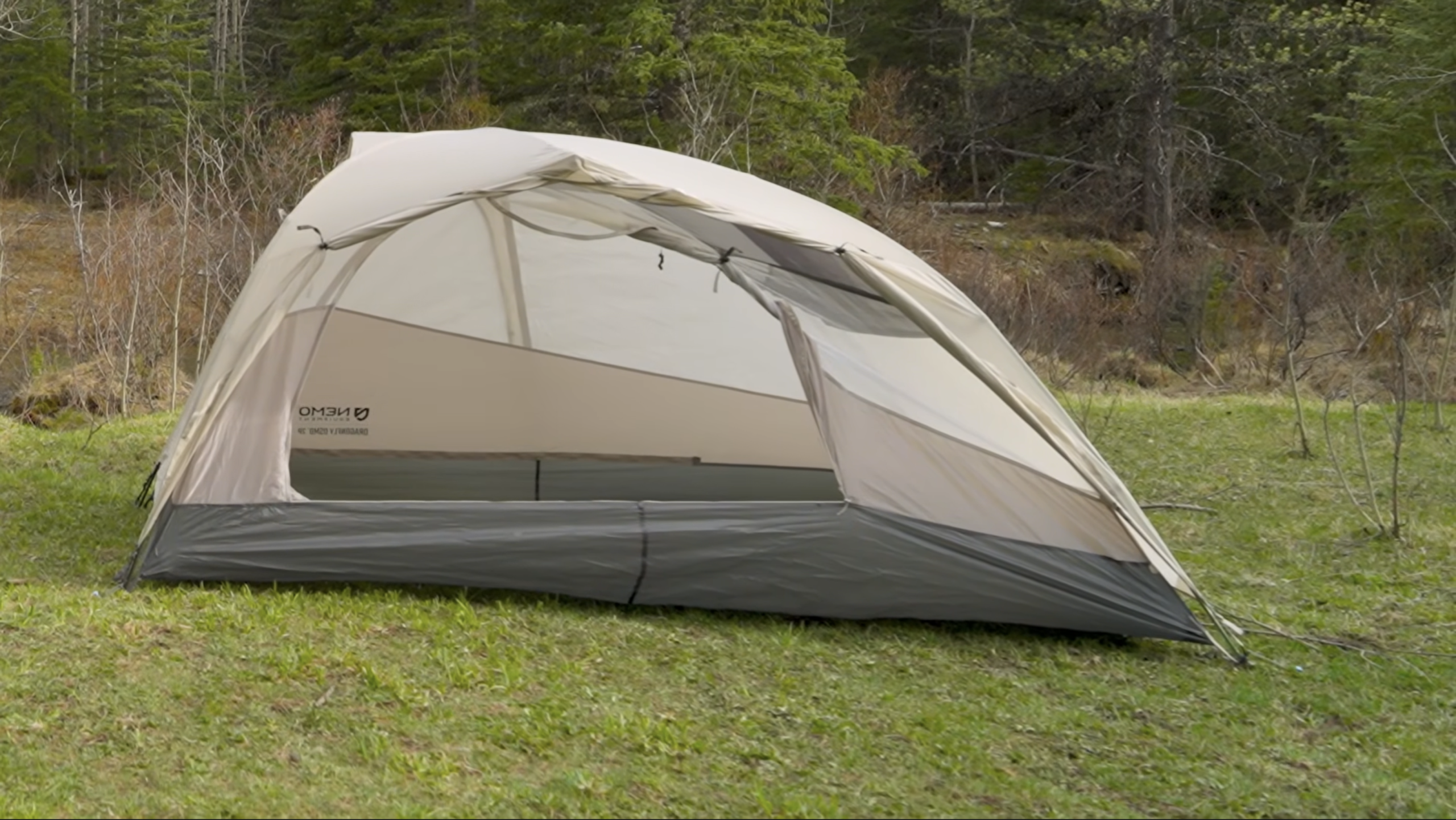
The NEMO Dragonfly OSMO 2P is a double-walled, freestanding two-person tent. It has a wide crossbar, tall doors, and generous interior space. NEMO says it is the perfect balance of weight and livability. After 15 nights of use and testing in all seasons, rain, and strong winds, I have a clear picture of the strengths and weaknesses with the tent. The Dragonfly 2P is a well-built, storm-ready tent with generous living space, with its main weaknesses being the tapered floor, pitching options, and its weight compared to trekking-pole tents.
Pros and Cons
Pros
- Generous living space, with a crossbar that pushes the walls close to vertical and leaves room for two to sit up at the head end.
- Stable and quiet in strong winds when fully staked and guyed out, with six stakeout points and six guyout points.
- The fly runs low to the ground, which prevents splashback and keeps rain out of the inner.
- Easy to get in and out of, with straight dual zippers that work with one hand.
- Colour-coded poles make the inner-first pitch quick and familiar.
- Two good-size vestibules, plenty of pockets, and an included Landing Zone tray for dry gear storage.
- Well built, with robust aluminum poles, excellent cordage and sewing, and NEMO's lifetime warranty.
- One of the lightest double-walled freestanding two-person tents not made with Dyneema fabric.
Cons
- The tapered floor cannot fit two rectangular regular wide pads.
- Inner-first is the only pitching option, so the inside of the tent gets wet when pitching in rain.
- Heavier than single-walled trekking-pole tents.
- The fly clips are hard to release from the corner anchors in mud or snow.
- The door tiebacks are finicky, and only the foot-end door can be staked closed.
- A single vent at the head end, with no second vent for a cross-breeze.
- The folded pole set is too long to fit horizontally in most packs.
• Inner tent (if applicable)
• Tent floor
• Poles (if applicable)
• Any pre-attached guylines
Tap outside the box to close
• Attached and optional included guylines
• Included tent stakes
• Poles (if applicable)
Tap outside the box to close
Weight score: 4/10
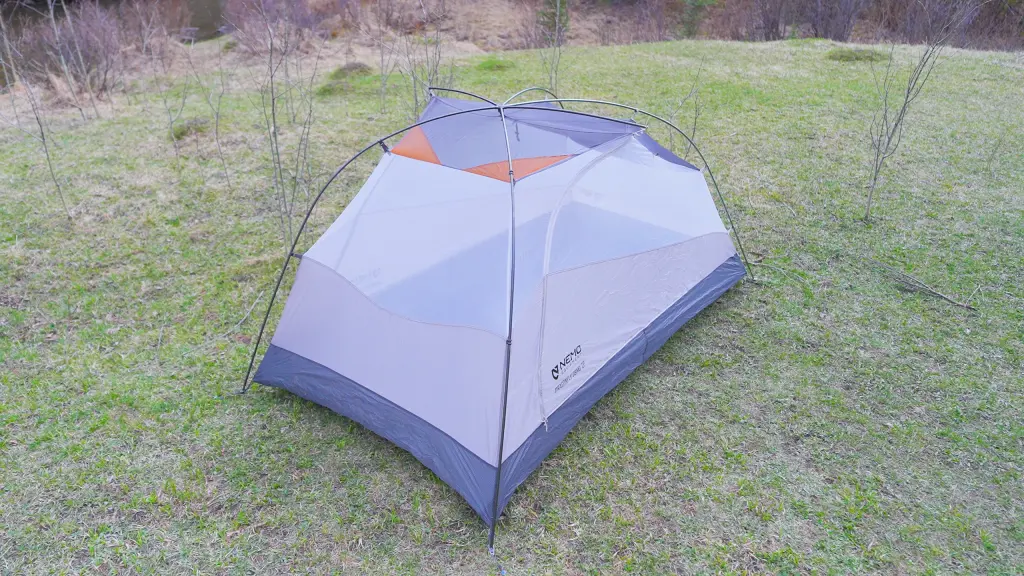
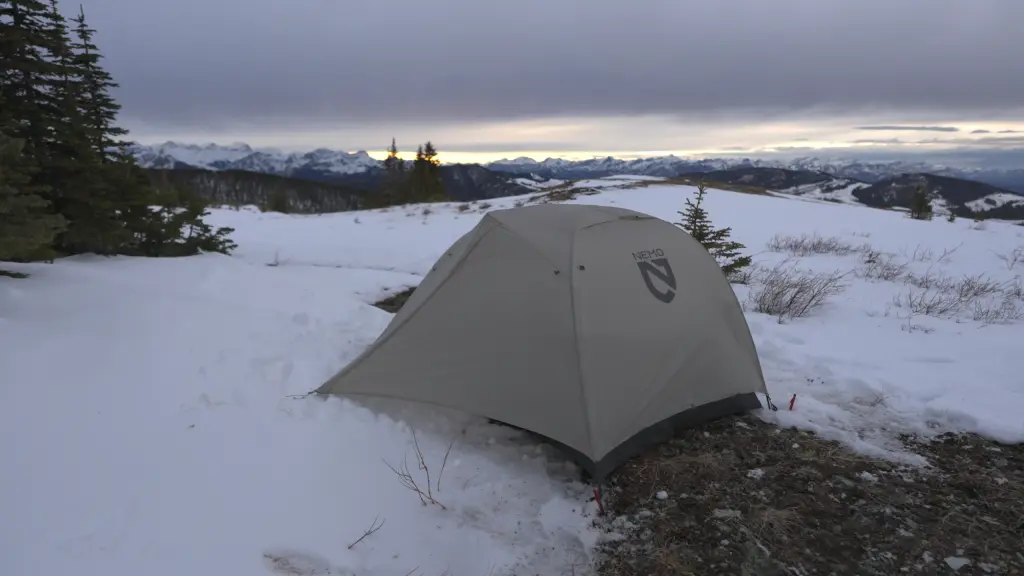
On my scale, the trail weight for the NEMO Dragonfly 2P is 1.23 kg (2.7 lb); which is less than the advertised minimum weight of 1.26 kg (2.8 lb). NEMO lists the packed weight, with stakes, guylines, and stuff sacks as 1.49 kg (3.3 lb).
The Dragonfly 2P is on the heavier end for a two-person tent because it is a double-walled, freestanding tent with a full pole set. A single-walled trekking-pole tent weighs significantly less. But for a double-walled freestanding tent, the Dragonfly 2P is one of the lightest two-person tents not made with Dyneema fabric.
The tent packs to about 52 cm (20.5 in) by 15 cm (5.9 in) by 7.6 cm (3 in) in its Divvy Cube stuff sack, which is a flat rectangle rather than a tube and can be compressed when the poles are not stored in the stuff sack. The folded pole set is 48.3 cm (19 in) long, which is too long to fit horizontally in most packs.
Ease of Use score: 8/10
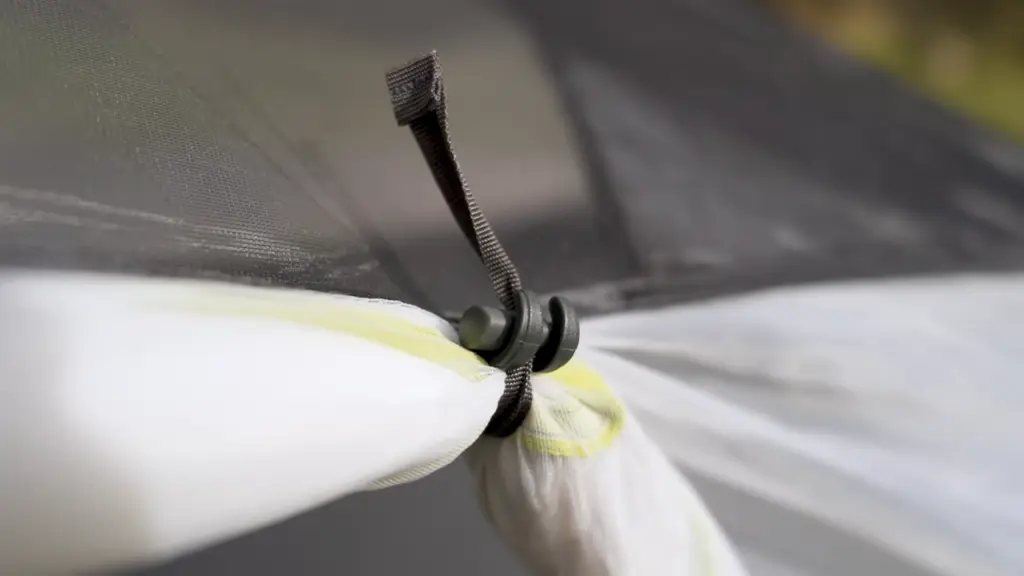
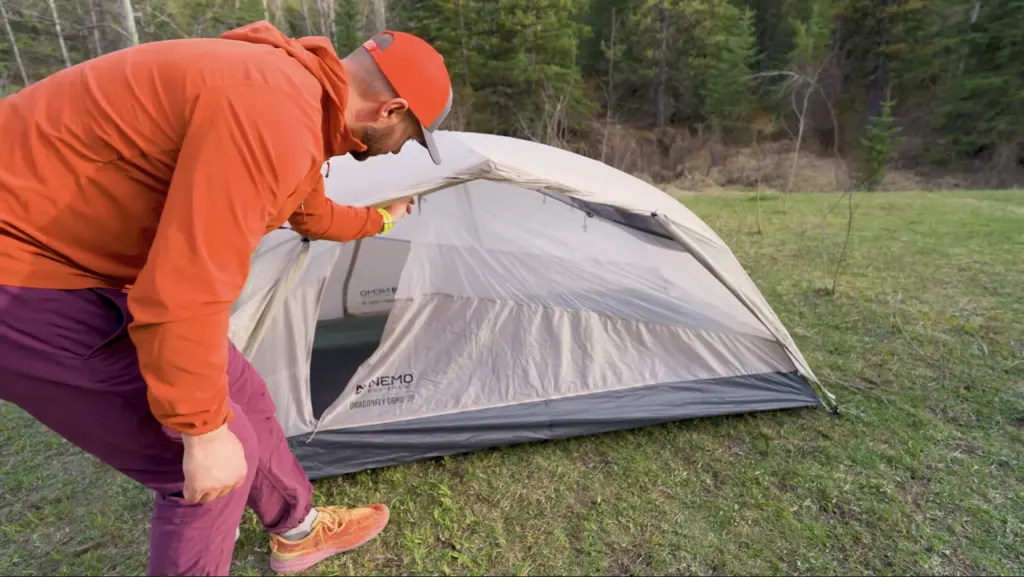
The door tiebacks are finicky and only the foot-end door panel can be closed on its own.
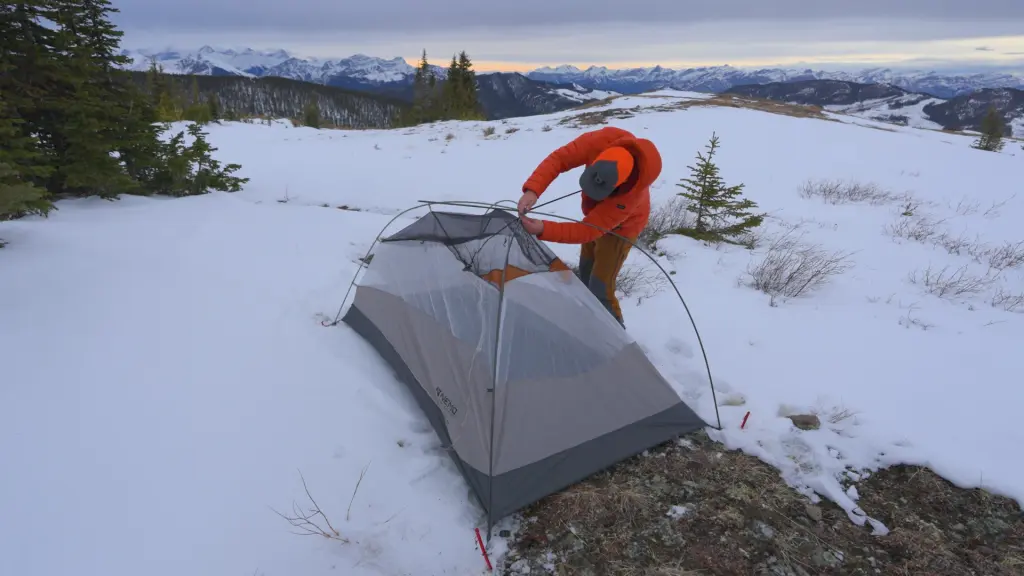
The inner clips to the hubbed pole set and the fly goes on over the top.
Ease of use is a strength of the NEMO Dragonfly 2P, with a few small features I am hesitant about. The Dragonfly 2P only has one pitching option: inner first where you set up the inner tent with the pole structure and then install the fly over top. This setup method is pretty standard and will likely be recognizable for anyone who has pitched tents before. The pole set is colour coded to the corners, which helps with the ease of setup. The inner and fly separate so the inner can be used on its own in dry weather and the fly can be stored separately from the inner if it is wet. There are no fly-first or all-in-one pitch setup options for the Dragonfly 2P; this is a drawback because, during an inner-first pitch, the inside of the tent gets wet during setup in rain.
The corner anchors and the way the fly clips into them work but they are not as easy to use as some other systems. In mud or snow, the fly clip is hard to release from the corner anchor. Getting in and out of the Dragonfly 2P is easy. The door uses a dual zipper system, with one zipper running along the bottom of the door and a second running up toward the ceiling. Dual zippers without curves snag less than a single curved zipper and will potentially last longer as well. All of the zippers for the tent can be used with one hand. The crossbar curves upward, so getting in and out of the tent is easy. Kneeling in front of the open door, I can see the whole inside of the tent, which makes grabbing gear simple.
Two features I do not like with the Dragonfly 2P are the door tieback mechanisms and that only one door panel can be staked. I have never liked the NEMO style of door tieback. I find it finicky and not easy to use. It takes me longer to tie back a NEMO door compared to other tents. For the door panels, both doors of the fly open and can be tied back, but you do not have the option to only have the foot-end door open since there is no cordage for a stakeout point on the head-end door. Normally the foot-end of the tent faces the wind, so the foot-end panel closing makes sense; but if the wind shifts and I want protection at the head-end, there is no way to do it.
Stormworthiness score: 7/10
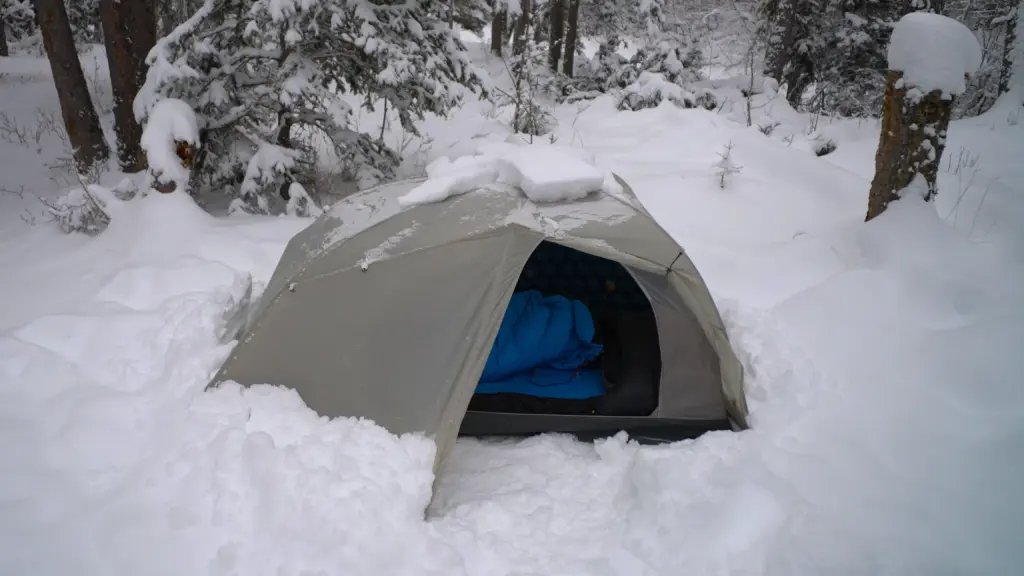
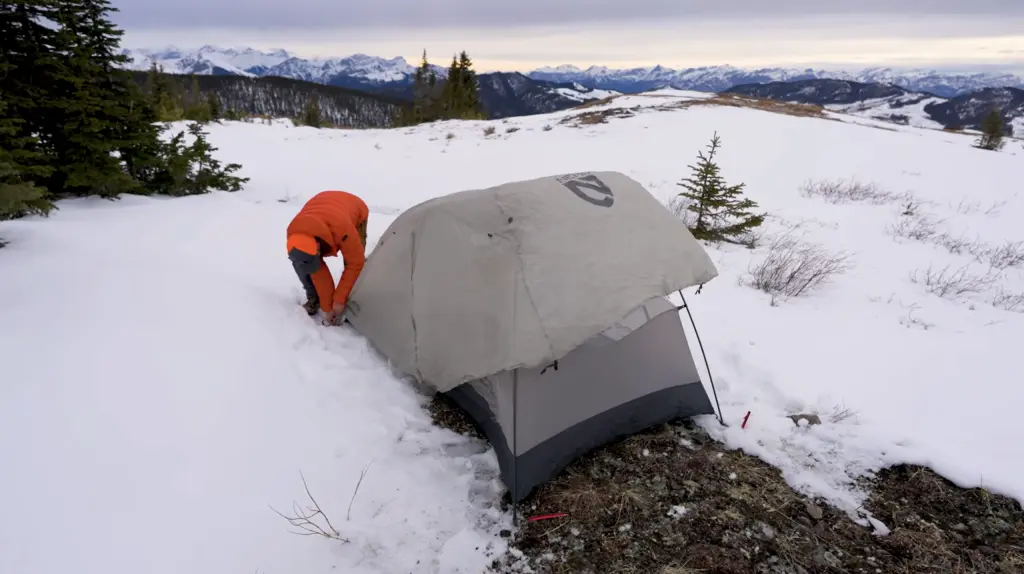
With the tent fully staked and guyed out, the Dragonfly 2P stays solid and quiet in strong wind.
Stormworthiness consists of how a tent holds its structure in strong wind and how it performs in rain. The NEMO Dragonfly 2P performs well in both wind and rain. For wind performance, the Dragonfly’s roominess and upturned browpole means larger fabric panels, which can catch more wind than smaller panels. When setting up the tent, pitch the foot-end into the wind since it is the lower and narrower end of the tent.
A standard pitch for the Dragonfly 2P uses six stakes: one at each of the four corners and one at each vestibule. There are six additional optional guyout points on the fly. With all six stakeout points and six guyout points in use, the Dragonfly 2P is fairly stable in strong winds. I have had the Dragonfly 2P out in gusts of about 50 km/h (31 mph) with the tent fully staked and guyed out and it felt solid. The tent was quiet during the strong winds I experienced, with no flapping or shaking of the tent.
The pole set is thick, robust aluminum, so I expect it to handle wind without a problem. The fly is NEMO's polyester-nylon ripstop and it does not sag or stretch when wet. A fly that sags in the rain loses tension and a loose fly reduces the stability of the whole tent in the wind. For keeping wind out of the tent, the inner has a tall, solid bathtub floor and a lighter but still windproof fabric that runs about halfway up the walls. The balance of solid materials and mesh keeps wind and cold off a sleeper while still leaving enough mesh for ventilation.
The fly runs almost all the way to the ground at the head end and the low fly around the rest of the tent prevents splashback and the solid inner panels that run high up the walls keep anything that does get under the fly out of the tent. Rain coverage with a door fully open is good but not complete but you can get full coverage by only partially opening the door zipper. Rain noise on the fly is minimal.
Condensation score: 6/10
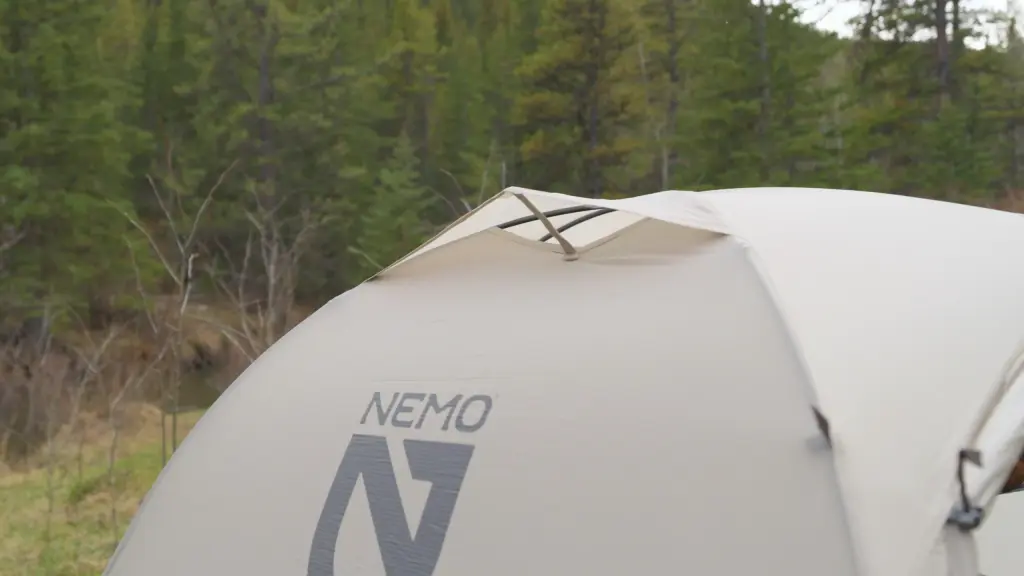
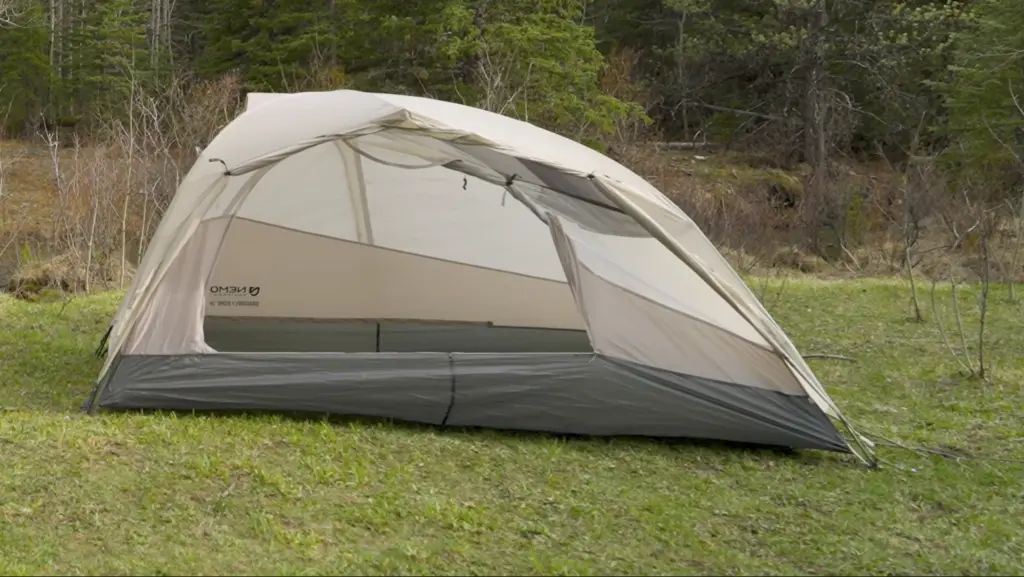
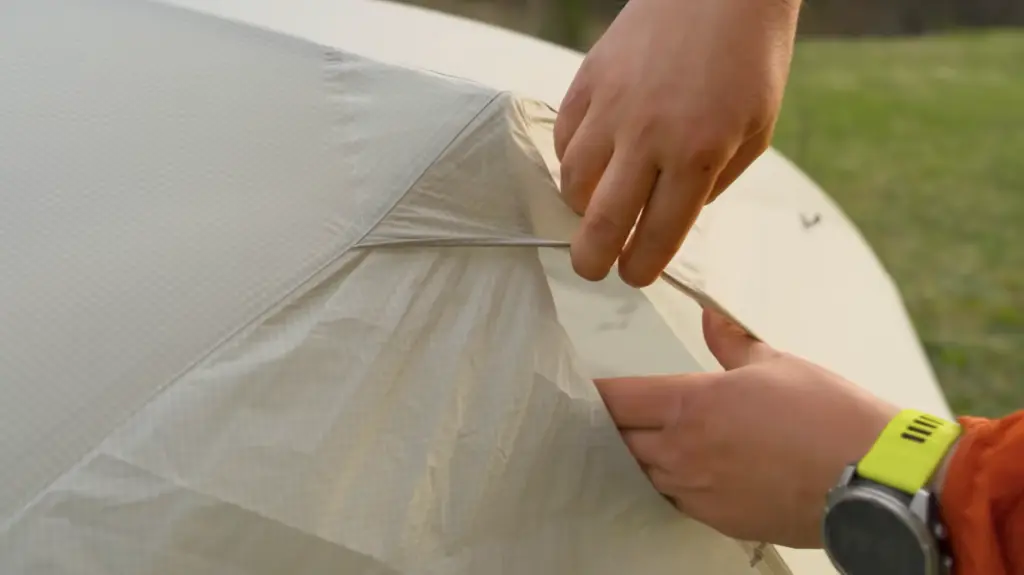
The tops of both doors open for more air movement, with a flap to protect the opening.
Condensation is well managed with the NEMO Dragonfly 2P. It is a double-wall tent, so the inner provides a physical barrier between the sleeper and the inside of the fly (where condensation forms). A double wall does not reduce condensation, but the barrier keeps gear and sleeping bags away from a wet fly.
For ventilation the Dragonfly 2P has a large vent at the head end. I wish there was a second vent at the foot end to create a cross-breeze. The larger interior of the tent helps with condensation as well. The crossbar adds air volume in the upper part of the tent and I have found that more air volume inside a tent leads to less of a temperature gradient between the inside of the tent and the air outside - which results in less condensation. Overall, the Dragonfly 2P has normal or slightly better condensation performance.
Livability score: 8/10
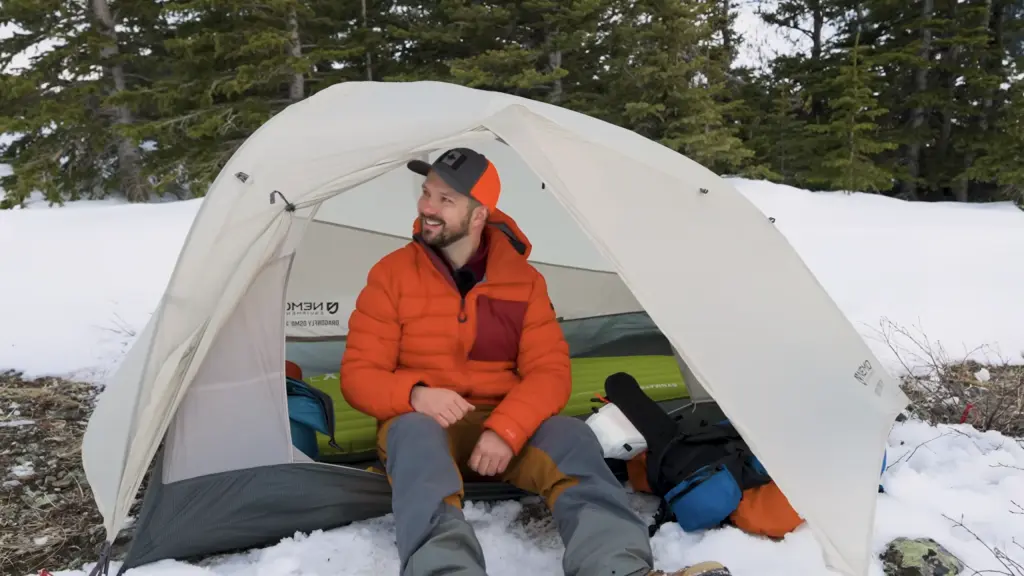
The crossbar pushes the walls close to vertical at the head end, which leaves room to sit up.
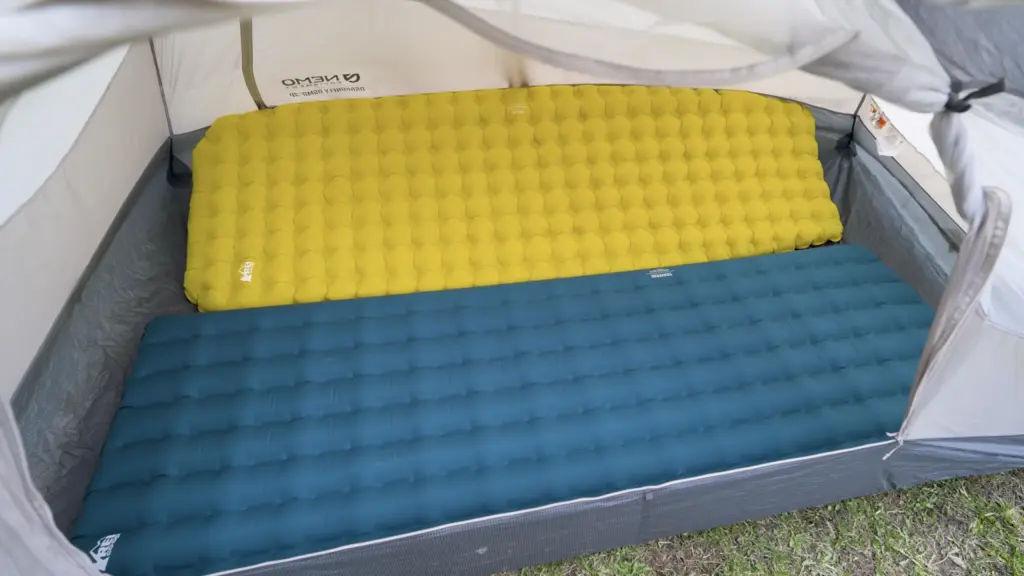
Two wide 63.5 cm (25 in) rectangular pads do not fit in the 2P because of the tapered floor.
Livability is the best thing about the NEMO Dragonfly 2P, with one important limitation. The Dragonfly 2P has a good amount of space inside, but it uses a tapered floor to save weight. The floor is 127 cm (50 in) wide at the head end and 117 cm (46.1 in) wide at the foot end. I am unable to fit two rectangular regular wide sized pads in the Dragonfly 2P. The tent is long enough to fit long pad fits. The three-person NEMO Dragonfly 3P is an interesting option because it provides enough space for two rectangular regular wide pads with lots of room to spare - while only weighing 280 g (9.9 oz) more than the 2P. The 3P is also longer, which allows for more internal storage of gear at the head or foot end.
The crossbar pushes the walls outward near the top, so they are closer to vertical. Sitting up in the middle or head end of the tent feels roomy, even if sharing the tent with a second person. The foot end tapers and slopes down, which leaves less room to sit up in that part of the tent. Stretching and changing are easy with one person inside and tight with two. The sidewalls are vertical at the head end, so the material is far from your face when lying down. With two people inside, there is little floor space left for gear; so packs stay in the vestibules and small items go in the pockets.
The Dragonfly 2P has a large pocket in the ceiling at the foot end, two pockets on the side at the head end, and small ceiling pockets meant for headlamps that work for anything small. The tent has two good-size vestibules and NEMO includes one Landing Zone with the tent - a small bathtub-style tray that sits in a vestibule for dry gear storage. Each vestibule holds a pack, shoes, and an assembled camp chair. The peak height is 101.6 cm (40 in) and the crossbar keeps that height over more of the tent than a single ridge would. With the tent fully guyed out, the Dragonfly 2P has enough space to hang out in and weather out a storm, if needed.
Durability score: 9/10
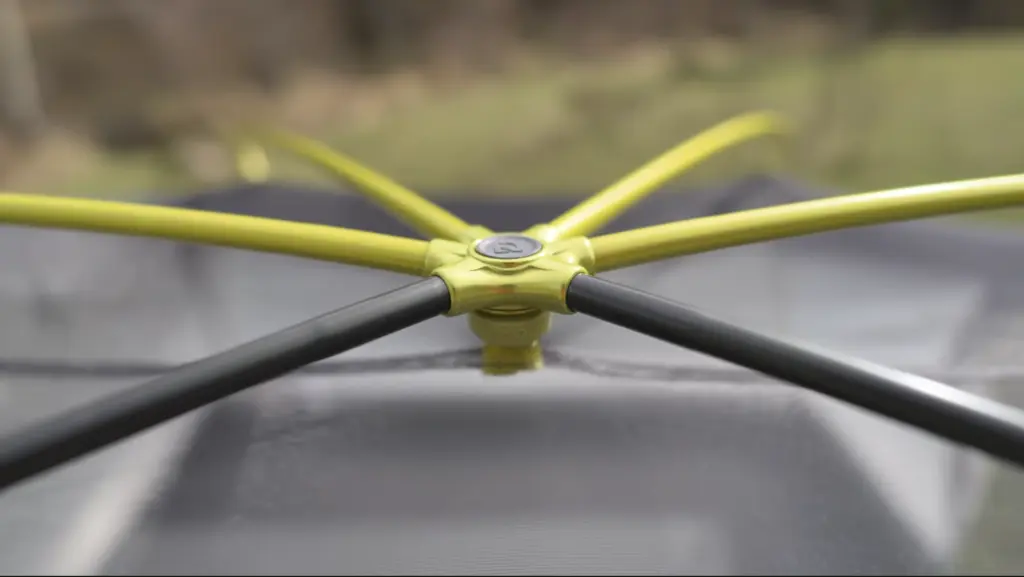
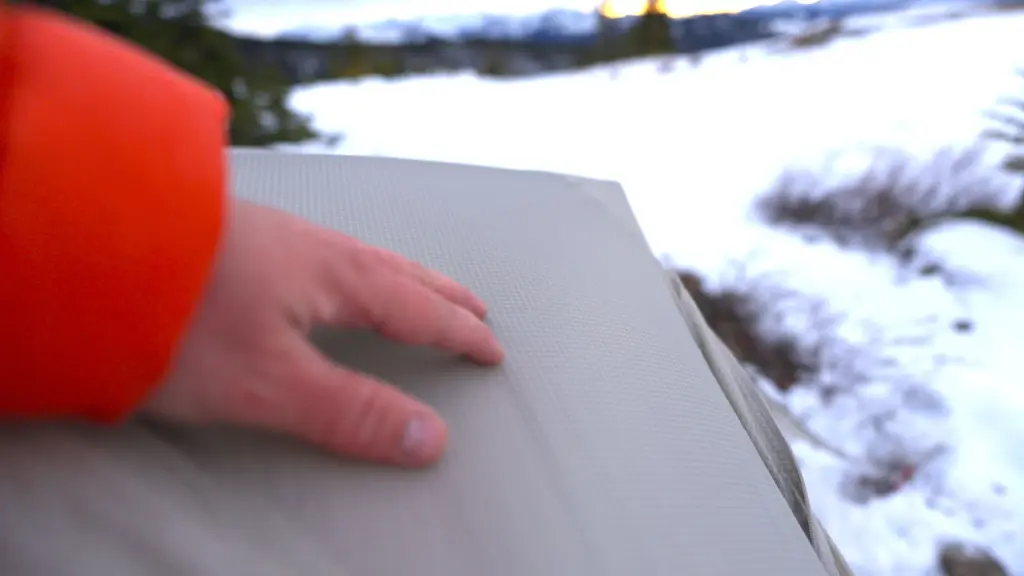
The fly and floor are NEMO's OSMO poly-nylon ripstop, which does not sag or stretch when wet.
For durability, the NEMO Dragonfly 2P uses NEMO’s OSMO polyester-nylon ripstop material for the fly and floor and 7000-series DIAPOLE hubbed aluminum tent poles. I have never had a problem with OSMO fabrics leaking or being damaged and I have not read reviews from others who have either. The 1500 mm hydraulic head rating for the fly might be a concern for some people, but I have not had any leaking through the fabric during heavy rain.
Zippers can be a major failure point on tents but the lack of significant curves and the use of a dual-zipper design for the inner reduces the likelihood of failure with the Dragonfly 2P. The cordage, clips, and buckles are excellent and so is the sewing quality. At the time of this review, REI had about 66 reviews with an average rating of 4.4 out of 5. The common complaints are about the corner anchors and fly clips being tricky, which I noticed too, rather than about fabric or pole failures.
NEMO backs every product with its lifetime warranty. I have used it as a regular customer, not as a reviewer, so I got the real experience of it, and the process was easy.
Final Thoughts
The NEMO Dragonfly 2P excels at livability, storage, and stormworthiness for a tent of its weight. It is an intuitive tent that performs well. It is probably the best option among two-person tents for anyone who values space a little more than weight. It is storm-worthy enough for 99 percent of people and conditions.
The choice within the Dragonfly line matters as much as the choice against other tents. The 2P cannot fit two wide rectangular pads and the 3P can, at a small weight penalty. For two people or two people and a dog, the NEMO Dragonfly 3P is the version most people will enjoy more.
How it compares
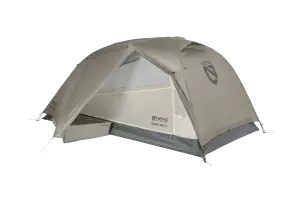 NEMO Dragonfly OSMO 2P NEMO Dragonfly OSMO 2P |
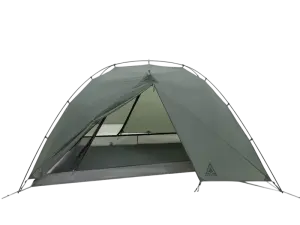 Durston X-Dome 2 Durston X-Dome 2 |
|
|---|---|---|
| Trail weight (measured)×Trail weight• Tent fly • Inner tent (if applicable) • Tent floor • Poles (if applicable) • Any pre-attached guylines Tap outside the box to close |
1.23 kg (2.7 lb) | 1.25 kg (2.8 lb) |
| Packed weight (advertised)×Packed weight• Entire tent structure • Attached and optional included guylines • Included tent stakes • Poles (if applicable) Tap outside the box to close |
1.49 kg (3.3 lb) | 1.34 kg (3 lb) |
| Capacity | 2-person | 2-person |
| Peak height | 101.6 cm (40 in) | 109.2 cm (43 in) |
| Interior space | 2.7 m² (29.1 sq ft) | 2.97 m² (32 sq ft) |
| Setup | Freestanding | Freestanding |
| Overall Rating | A- | A+ |
| Weight score | 4/10 | 6/10 |
| Ease of Use score | 8/10 | 9.5/10 |
| Stormworthiness score | 7/10 | 8/10 |
| Durability score | 9/10 | 9/10 |
| Livability score | 8/10 | 9/10 |
| Condensation score | 6/10 | 9/10 |
| Check price | Check price |
Against the competition, I really like the Durston X-Dome 2. It is an amazing tent that fits two wide rectangular pads. It may be a little more storm-worthy and it is a little lighter than the Dragonfly 2P. The X-Dome only comes in a two-person size though, while the Dragonfly offers the roomier 3P version. If I were leaving on a trip right now, choosing between the Dragonfly 3P and the X-Dome 2 would be a very close decision.
More Tent Reviews
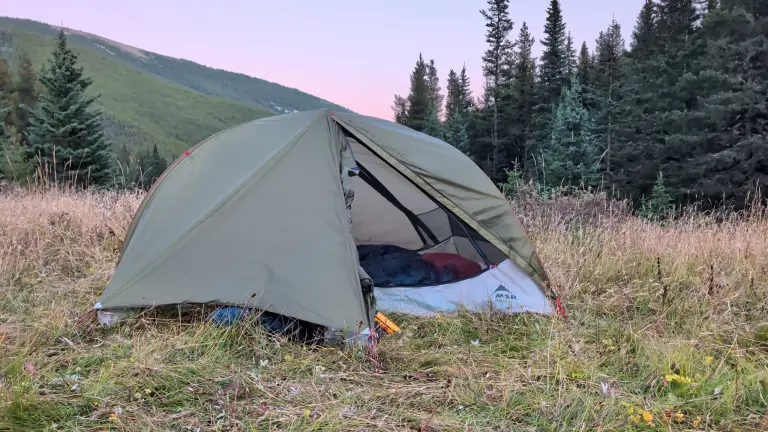
MSR FreeLite Stash 2P
Light and compact semi-freestanding true 2-person tent with lots of good livability.
The MSR FreeLite Stash 2P is a 2-person double walled semi-freestanding tent meant for lightweight backpacking trips. The trail weight for the tent is ## on…
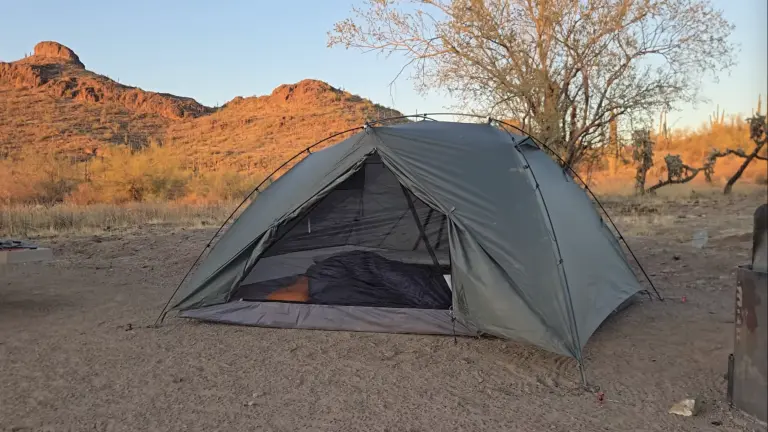
Durston X-Dome 2
Roomy, versatile, and light two-person fully freestanding tent that can handle a big storm.
The Durston X-Dome 2 is a double walled, fully freestanding two-person tent. Durston claims it provides unprecedented space and protection for its weight. I have tested…
Six Moon Designs Lunar Solo
A roomy ultralight single-pole trekking pole tent at a budget price, with a pitch that takes practice.
The Six Moon Designs Lunar Solo is a single-wall, one-person tent that pitches with one trekking pole. Six Moon Designs describes it as an ultralight tent…